How Our Family of Four Travels Four Times a Year Without Breaking the Bank
Updated: 7 days ago
We didn't suddenly find more money for travel. We changed what we wanted our money to do. Here's how our family prioritizes experiences, plans our spending, stacks travel savings, and keeps putting another adventure on the calendar.
In the fall of 2022, we had just returned from our very first trip to Universal Orlando with all four of us.
It was also, simultaneously, the very first trip the four of us had taken together. Period.
Before leaving, we can remember the slight anxiety and negative thoughts creeping in about how difficult it might be to travel with a toddler and a little guy who could hardly walk a straight line when we asked him to.
Those doubts disappeared almost immediately.
They were replaced by joy, excitement, and a mental switch that suddenly opened an entire world of opportunities for more frequent adventures and bigger memories for our family.
As we unpacked, a universal feeling settled over the household. And yes, the pun is absolutely intended.
Mom and Dad kept looking at each other in disbelief that our amazing first adventure was already over. Gryffin wouldn't let go of his new favorite stuffy from the parks. Selene immediately started asking when we could go back.
In fact, Selene was the positivity driver, and still is. There was never an if in her mind. She simply assumed we were going back in the not-too-distant future.
Our hearts had been squeezed by the travel bug.
It still hasn't loosened its grip.
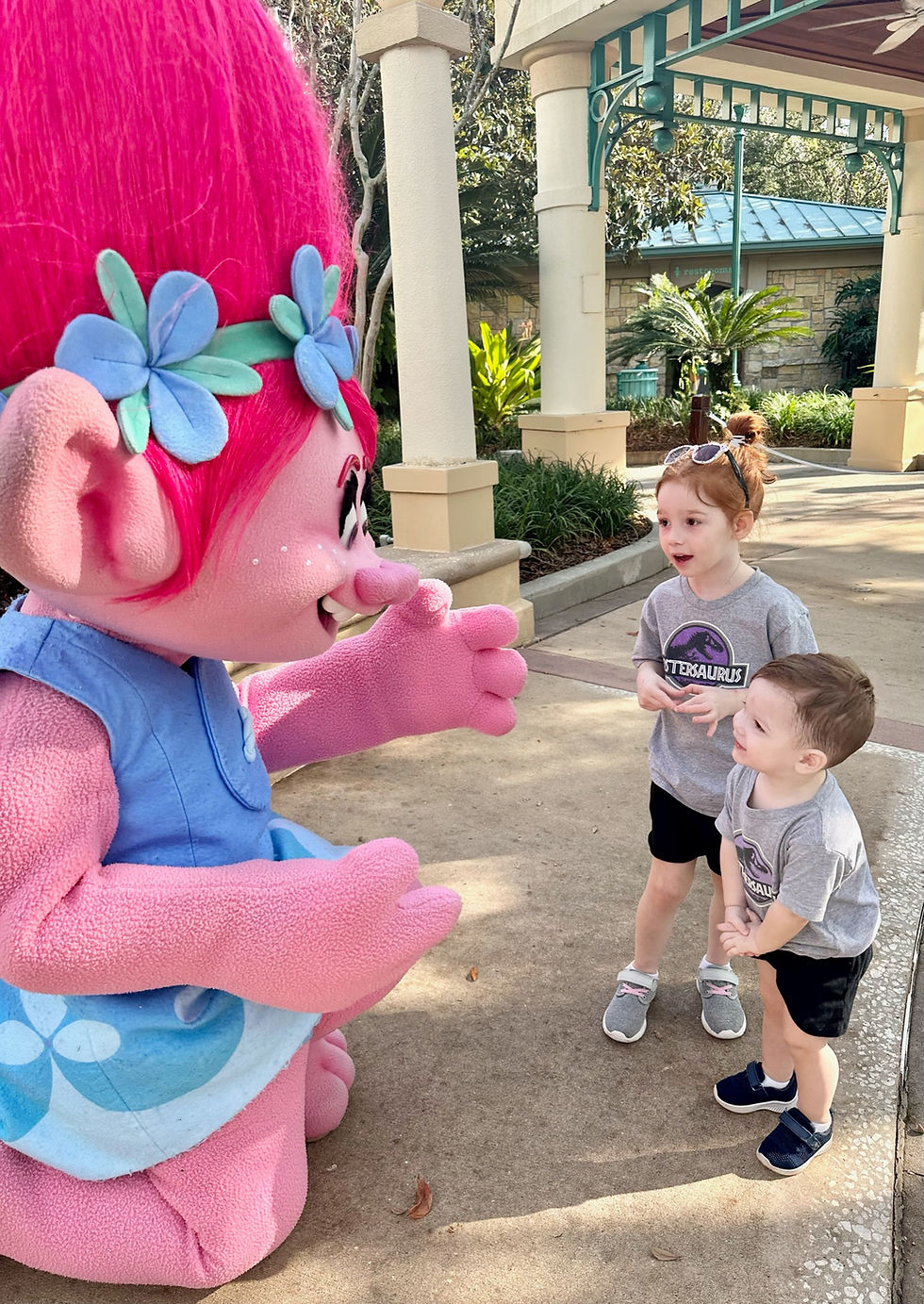
But we realized pretty quickly that it wasn't just the destination we loved.
It was having the ability to maximize our fun as a family and be completely present with each other without all the little interruptions that day-to-day life brings with it.
We knew we'd found something we wanted more of.
The question became:
How do we build our normal life in a way that lets us keep doing this?
Travel Became Something Our Money Was For
We wholeheartedly believe that income alone doesn't dictate how frequently our family gets to travel.
For us, it's the intentions we put into action that make it happen.
In our day-to-day lives, we go to school. We go to work. And we try to keep things as simple as possible without constantly spending money on unnecessary extras.
Our mindset is that money is a tool.
And one of the things we want that tool to accomplish is helping our family get outside our little hometown bubble as often as possible.
That means purchases frequently get measured against something bigger.
If spending money on something today is going to push back an adventure sitting on the horizon, it has a much harder time earning a "yes" vote.
Every year, we strive to be on a plane heading somewhere roughly once every three months.
And the more we travel, the better we've become at fine-tuning our financial system to push toward bigger destinations, more frequent adventures, or sometimes both.
💡 THE S&G APPROACH: We don't treat travel as whatever happens after everything else gets our money. We intentionally make it one of the things our money is supposed to accomplish.
We Flipped the Traditional "Save for the Big Trip" Mindset
Growing up, we're sure we've all heard some version of:
"We need to save for the big trip."
Or:
"One trip a year is what we can afford."
And we absolutely believe the day-to-day financial foundation comes first. Our regular expenses need to be covered, and we want emergency savings available for the decidedly less-fun surprises life enjoys throwing around.
But after establishing that foundation, our family started approaching travel differently.
Instead of always waiting until every dollar of a trip was sitting untouched in a dedicated pile before making a reservation, we sometimes work backward.
We identify the trip we want, determine whether it fits within the financial boundaries we've established for ourselves, book it, and then enter replenishment mode.
The money we've committed to the adventure becomes money we're determined to replace before moving on to the next one.
For us, that creates accountability.
If the saving doesn't happen on the back end, we don't book the next trip.
That simple rule keeps us disciplined.
IMPORTANT: This is simply the system that works for our family. We aren't financial professionals, and we don't believe anyone should jeopardize emergency savings, take on unaffordable debt, or ignore essential expenses to travel.
Little Decisions Compound Into Big Adventures
Once an adventure is on the calendar, something interesting happens.
Every trip to the grocery store becomes a little more calculated. Extra activities and purchases get weighed against what they'll cost us in progress toward the next adventure.
Even the kids are starting to understand the concept.
Because it's the little things that add up.
Compounding is probably one of the biggest concepts at work in our lifestyle, and not only financially.
Every trip also teaches us something that makes the next one more efficient:
Better booking timing.
Smarter packing.
Knowing which costs are worth paying.
Knowing which ones aren't.
Learning what our family actually values while traveling.
Over time, all those little lessons start stacking on top of one another.
Our Very Grand-Sounding "Master Budget"
At the beginning of every year, or whenever there's a major financial change like a pay raise or new vehicle, we pull out our family's Master Budget.
Cue dramatic echo.
Master Budget... Budget... Budget...
It sounds significantly more sophisticated than it actually is.
It's a spreadsheet where we document every net dollar coming into the household each month and get as close as possible to documenting every dollar going out.
Most expenses remain relatively consistent:
Mortgage.
Vehicles.
Utilities.
Insurance.
The usual suspects.
Variable expenses require a little more detective work.
For something like groceries, Dad may run a three-month deep dive tracking what we're actually spending so we can establish a realistic monthly number rather than simply guessing what it feels like we spend.
The spreadsheet becomes the backbone of our financial framework.
It shows us what's left over each month and, more importantly, where spending might be quietly leaking out.
The $40-a-Month Test
Subscriptions are sneaky little things.
Individually, they rarely look like game changers.
But let's say we find $40 per month worth of subscriptions we don't really use.
Starting in January, that's:
$40 × 12 months = $480 by December.
Suddenly that doesn't feel insignificant.
For one of our trips, $480 might represent two hotel nights.
It might cover a rental car.
It might knock out a large chunk of our food budget.
And it came from something as simple as deciding we didn't need Disney+ and Paramount+ at the same time and letting Bluey and Ninja Turtles hold down the fort elsewhere for a while.
That's the way we try to look at everyday spending.
Not:
"Will $10 make us rich?"
Of course not.
Instead:
"What could twelve months of these little decisions become?"
Sometimes the answer is another piece of an adventure.
Stack Savings Wherever They Make Sense
When it comes to squeezing value out of travel, this is where Dad starts having entirely too much fun.
Our Universal Orlando annual passes are a perfect example.
It's one purchase that can unlock an entire collection of additional value throughout the year: park admission, discounts on purchases, potential hotel savings, and other benefits depending on the pass level.
For a family that visits Universal frequently, we aren't evaluating the passes based on one vacation.
We're evaluating what they allow us to do across an entire year.

Then we start stacking logistical savings on top of those benefits.
Our recent trip aboard Utopia of the Seas is a perfect example.
We were sailing out of Port Canaveral.
The easiest and most affordable flight option for us was Orlando.
Well...
How could we possibly fly into Orlando and not stop at Universal?
We already had annual passes, so visiting the parks didn't require buying another set of park tickets.
Our pass also helped us secure a hotel rate that made staying at Universal before the cruise financially competitive with our other options.
One travel decision started helping another.
It's a melty snowball of savings and fun.
Let Pricing Help Choose the Dates
Another major piece of our strategy is traveling during shoulder seasons and looking for dates with lower demand whenever our schedule allows it.
This is entirely dependent on each family's circumstances and comfort level, but we generally try to avoid the biggest holiday periods and Spring Break when possible.
Those periods tend to bring higher demand, larger crowds, and often higher prices across multiple parts of the trip.
Instead of deciding:
"We are traveling these exact dates. Now find us a trip."
we often reverse it:
"We want to travel around this general time. Show us where the value is."
A little flexibility can completely change what's possible.
Airline fare calendars are particularly useful because flight pricing can give us an early indication of which dates may make the most sense to investigate further.
From there we compare hotels, cruises, transportation, and the rest of the trip.
💡 WHAT WE LEARNED: Sometimes the biggest travel savings don't come from a coupon or secret hack. They come from being willing to leave on Tuesday instead of Saturday.
We Don't Force a Trip That Doesn't Fit
One of the biggest reasons this system works for us is because of something we don't do.
We don't force a particular trip when the numbers don't fit within what we're comfortable spending.
Spring Break is the easiest example.
We'd love to be the perfectly behaved parents who align every adventure with the school calendar so we don't receive another stern phone call from the principal congratulating us on yet another trip taken outside a designated break.
She understands.
She also has a job to do.
And we accept our fate.
But shifting a trip by even a week can sometimes mean smaller crowds and meaningful savings.
So we compare.
If traveling during the school break makes sense, great.
If moving the trip creates substantially better value and works for our family, that's something we'll consider too.
The important part is that we aren't booking a particular vacation simply because the calendar says we're supposed to travel then.
The Small Feet Perspective
Something unexpected has happened as we've built travel into our family's financial priorities:
The kids are learning why we make choices.
They don't need to understand spreadsheets, household income, or travel pricing.
But they're beginning to understand that saying "no" to something today doesn't always mean we're losing something.
Sometimes we're choosing something else.
Maybe it's another day at Universal.
Maybe it's waking up on a cruise ship.
Maybe it's their first airplane ride somewhere completely new.
And that's a lesson we hope sticks around long after they've stopped needing Mom and Dad to pack their suitcases.
Money isn't only about buying things.
It can also create opportunities.
And some of our favorite opportunities happen to require boarding passes.

We're Still Figuring It Out
We're not financial experts, and we're not pretending to have everything figured out.
We're simply a family that decided travel wasn't going to be a luxury we'd hopefully get around to someday.
It was something we wanted to build our lives around right now.
The math is rarely perfect.
The budget gets tested every time something unexpected comes up.
Plans change.
Prices change.
Life definitely changes.
But every time we're sitting in an airport with two kids and our carry-ons, heading somewhere new, we know those calculated grocery runs, skipped purchases, carefully chosen travel dates, and canceled subscriptions were worth it.
For our family, that's the trade.
Work hard.
Save intentionally.
Spend on what matters to us.
Keep exploring.
And let all those little decisions compound into something much bigger.
Small Feet. Big Adventures.
Comments